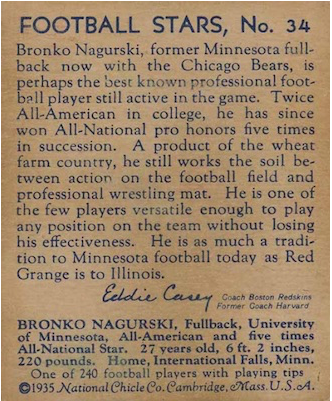
One of the most fascinating aspects of the 1935 National Chicle football set isn’t found on the beautifully illustrated fronts — it’s on the backs.
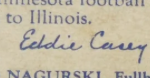
Each card features football playing tips written by former coach Eddie Casey, offering instructional advice rather than player statistics. In an era before detailed stat tracking became standard on trading cards, this coaching perspective gave young fans insight into how the game was played and taught in the 1930s. It’s a unique feature that adds personality and educational value to the set.
But there’s something even more intriguing printed on every reverse.
Beneath the coaching tips appears a statement that each card is “one of 240 football players” in the set.

Of course, collectors know today that only 36 cards were ever released.
The “240 Players” Mystery
The reference to 240 players has puzzled collectors for decades. Hobby consensus holds that this was likely a printing error or abandoned production plan. It is widely believed that National Chicle originally intended to issue a much larger football set — potentially rivaling the size of contemporary baseball releases — but production was cut short.
Whether due to financial pressures during the Great Depression, slower-than-expected sales, or logistical challenges, the ambitious 240-card vision never materialized.
Instead, the set stopped at 36 cards.
Two Series: 1–24 and 25–36
Further adding to the intrigue is the distribution pattern within the released cards.
Collectors have long observed that:
Cards #1–24 are more commonly found
Cards #25–36 are noticeably tougher
This suggests the set was likely printed and distributed in two series. The first 24 cards appear to have seen broader circulation, while the final 12 were distributed in smaller quantities, making them more difficult to locate today.
The result is a built-in scarcity tier within the set — even though it contains only 36 cards.
A Glimpse Into What Might Have Been
The “one of 240” statement offers a glimpse into what the 1935 National Chicle football set might have become. Had the full production run been completed, it would have been one of the most ambitious early football card issues ever attempted.
Instead, what survives is something arguably even more compelling:
A beautifully designed 36-card set filled with Hall of Famers, instructional coaching tips, and one of the hobby’s great unanswered printing mysteries.
Nearly a century later, that small line of text on the back continues to spark discussion — and adds yet another layer of intrigue to the first national football card set.